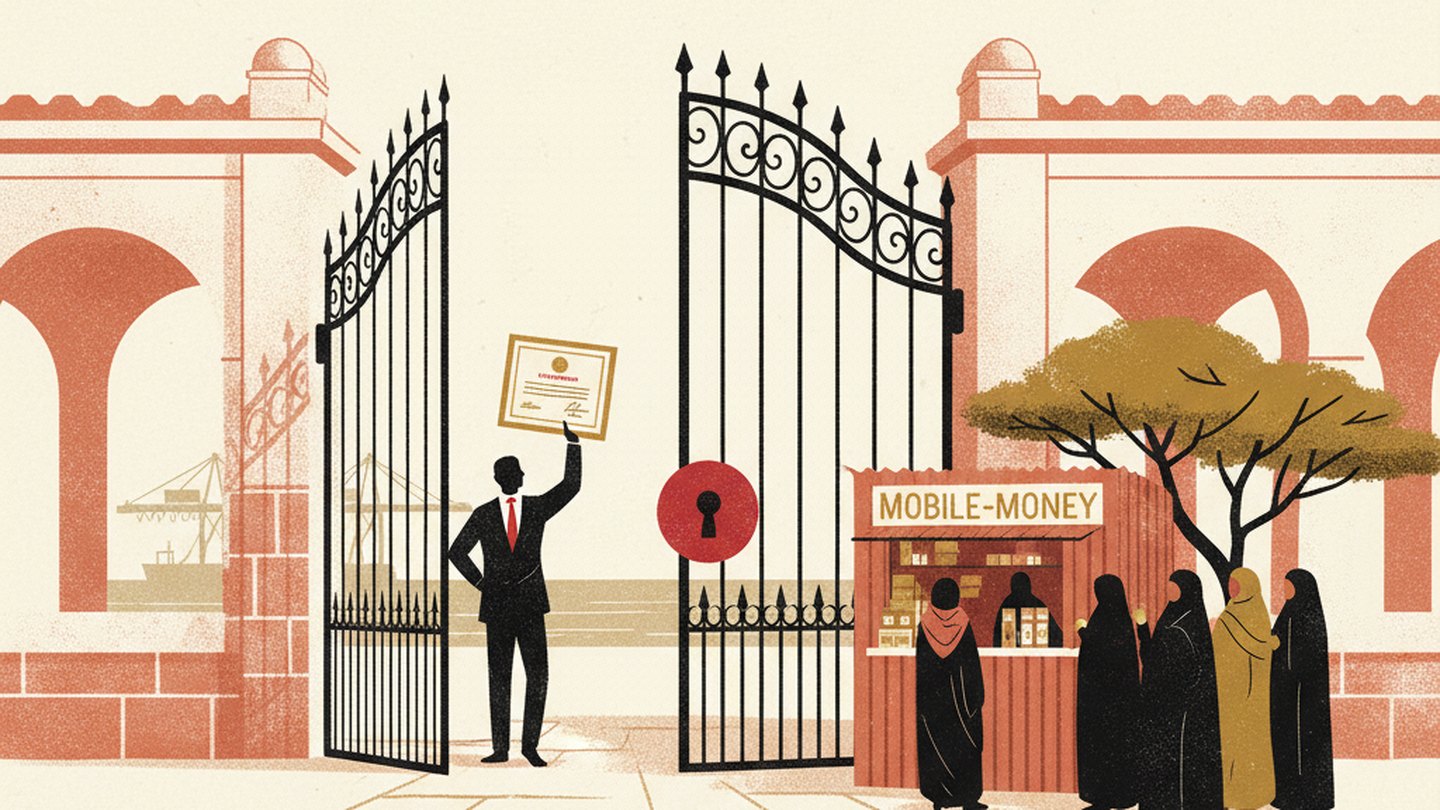
A foreign payments company can enter Somalia through licensed banks and still have a licensing question of its own. The hard part is often not the application. It is deciding what, legally, the foreign company is doing.
In 2025, we advised an international payments network on its entry into Somalia.
The local side of the structure included regulated financial institutions. That did not make the regulatory question disappear.
It made the question more precise.
What activities were the Somali institutions carrying out under their licences?
And what activities was the foreign network carrying out in its own right?
That distinction is now one of the first things we would ask any payments, fintech or financial-services business considering Somalia. The firm's work on that market entry included licensing, AML/CFT and payment-system analysis during the development of the newer regulatory framework.
The reason is simple:
a licence belongs to the licensed entity. It is not contagious.
01 — Somalia is not waiting to discover digital payments
There is another misconception worth clearing away first.
A foreign payments company is not arriving in Somalia to introduce consumers to digital finance.
Somalia already has one of the region's most distinctive digital-payment markets. Mobile money became deeply embedded in everyday commerce long before the formal regulatory framework caught up.
What has changed is the regulatory and institutional architecture around that market.
The Central Bank's National Payment System has operated since 2021. It now incorporates interbank clearing and settlement infrastructure, and the Somalia Instant Payment System, launched in January 2025, is designed for real-time 24/7 payments between banks, mobile wallets and other channels.
The Central Bank currently publishes separate licensed populations for commercial banks, money-transfer businesses, mobile-money services and microfinance institutions. It also publishes specific regulations for those categories, including mobile-money rules and 2025 licensing regulations for non-deposit-taking microfinance institutions.
That is the market an entrant is joining.
The interesting legal question is therefore rarely "does Somalia regulate payments?"
It does.
The question is where your particular business sits inside the perimeter.
Imagine a regional fintech planning a Somalia product.
Two Somali banks will hold customer accounts. The fintech provides the interface. Customers see the fintech's brand. Onboarding begins in the fintech's app. The local banks execute part of the regulated transaction, while technology and some compliance functions sit outside Somalia.
The commercial team sees a partnership with two licensed banks.
A regulator can see several activities performed by several legal entities.
Who contracts with the customer?
Who actually holds value?
Who initiates the payment instruction?
Who controls onboarding?
Who handles complaints?
Whose compliance programme governs which part of the activity?
Change the answer to one of those questions and the regulatory analysis can change with it.
That is why the right time to conduct perimeter analysis is before the product design becomes commercially expensive to change.
The licence opens one gate. The perimeter question is the next one.
02 — The 2025 laws changed the baseline
Somalia's financial rulebook also moved substantially in 2025.
The Central Bank now lists the 2025 Financial Institutions Law and the 2025 AML/CFT amendment among the principal instruments governing the sector. The same reform period produced a dedicated Takaful framework, followed by licensing and prudential regulations.
This matters to foreign entrants in a practical way.
A licensing strategy copied from the company's entry into Kenya, Rwanda or another market should not simply be renamed "Somalia."
The Somali regulator has its own categories.
It has its own institutional history.
And the market itself has its own architecture, particularly the relationship between banks, money-transfer businesses, mobile-money providers and telecommunications infrastructure.
AML/CFT deserves particular attention because it sits across the entire exercise.
A multinational financial business will usually arrive with a sophisticated group compliance programme. That is useful. It does not eliminate the need to map the programme to Somali requirements.
Beneficial ownership, onboarding, monitoring, reporting, local partners and the division of compliance responsibilities should be resolved as part of the operating model rather than left as language for the application.
There is also a second regulatory system that payments businesses increasingly need to think about at the same time: data protection.
Somalia's Data Protection Authority formally launched registration of controllers and processors in May 2026 and now operates a public registration framework.
For a payments company, the data and licence maps therefore overlap.
Where is customer information collected?
Which group company controls it?
Does a local bank send it to the foreign platform?
Does the foreign platform send information back?
Where is it stored?
A market-entry project that treats financial regulation and data regulation as two unrelated workstreams risks discovering that the same product design decision drives both.
03 — Local partnership is a strategy, not a substitute for analysis
None of this means foreign payments firms should avoid partnering with Somali financial institutions.
Quite the opposite.
Local-bank and institutional partnerships can be commercially and legally sensible ways into the market.
But the agreement should describe the structure that has actually been cleared, rather than becoming the document through which the parties discover the structure.
That sequencing sounds minor until the launch date exists.
Once integration work has begun, marketing is scheduled, commercial targets have been announced and local counterparties have committed resources, a regulatory conclusion becomes much harder to absorb if it requires the product to change.
This is one reason the legal work can look oddly front-loaded.
Before the polished partnership agreement, there may need to be a relatively unglamorous diagram.
Entity A does this.
Bank B does that.
Bank C holds this.
The customer sees this.
The data goes there.
The money goes here.
Then the lawyers can answer the interesting question:
what does each entity need in order to do what the diagram says it will do?
That is a much better place to begin a regulator conversation than with a ninety-page global compliance manual and an assumption that somebody else's licence must cover the product.
Somalia's payments market is becoming more regulated at the same time that its infrastructure becomes more interoperable.
That creates opportunity.
It also makes regulatory perimeter analysis more—not less—important.
A licensed local partner can be an essential part of the answer.
It is just not the answer to every entity's question.
General information only. Licensing depends on the specific activity, structure and current Central Bank requirements.
AM
Abdirizak Mustaf Ahmed leads Insaaf's financial-services practice — licensing, AML/CFT and regulatory engagement with the Central Bank of Somalia. He holds an LLB in Shari'ah law and an LLM in corporate law, because in this market they are one subject.
The Financial Services practice →